This page covers hospital wastewater residual chlorine monitoring under GB 18466 (Discharge Standard of Water Pollutants from Medical Institutions): total residual chlorine discharge limits, contact tank outlet chlorine control, monitoring frequency and test methods, together with practical online chlorine monitoring configurations.
Hospital wastewater contains clinical, domestic and fecal wastewater that may carry enteric pathogens, viruses and tubercle bacilli. Chlorine disinfection is the most common inactivation method, and residual chlorine is the intermediate indicator of disinfection effectiveness and discharge safety — both "insufficient disinfection" and "excess chlorine" must be prevented.
Insufficient chlorine at the contact tank outlet or inadequate contact time may leave pathogens incompletely inactivated, entering the sewer network or water body and creating infection transmission and compliance risks. Continuous monitoring feeds back chlorine dosing in time.
Excess residual chlorine discharged directly into surface water or sea is toxic to aquatic life and may be accompanied by disinfection by-products. The standard therefore sets a residual total chlorine limit at the final outlet, and dechlorination may be required.
The table is compiled from Tables 1 and 2 and related clauses of GB 18466-2005. It applies only to processes using chlorine-based disinfectants (sodium hypochlorite, chlorine dioxide, liquid chlorine, etc.); total residual chlorine is not regulated for UV, ozone or other disinfectants.
Bottom line: When medical institution wastewater is discharged directly into a water body, total residual chlorine at the final outlet is limited to 0.5 mg/L; contact tank outlet total residual chlorine is controlled between 2 and 10 mg/L by institution category, with the required contact time met.
| Institution category / discharge route | TRC at final outlet | TRC at contact tank outlet | Contact time |
|---|---|---|---|
| Infectious disease, tuberculosis institutions Direct discharge into water body (Table 1) |
≤ 0.5 mg/L | 6.5 ~ 10 mg/L | ≥ 1.5 h |
| General and other medical institutions Discharge standard: direct/indirect discharge into surface water or sea (Table 2) |
≤ 0.5 mg/L | 3 ~ 10 mg/L | ≥ 1 h |
| General and other medical institutions Pretreatment standard: discharged to sewer leading to a properly operated municipal secondary WWTP (Table 2) |
— (not specified) | 2 ~ 8 mg/L | ≥ 1 h |
Hospital wastewater usually goes through collection, pretreatment and secondary biological treatment before entering the disinfection contact tank, followed by dechlorination when required by the discharge route. Chlorine monitoring should be arranged at the contact tank outlet (to verify disinfection adequacy) and the final outlet (to verify compliant discharge and dechlorination effectiveness).
Compared with discrete manual laboratory tests, online monitoring continuously reflects chlorine trends, supports chlorine dosing/dechlorination interlock and retains regulatory records. A typical online chlorine system for hospital wastewater consists of sampling pretreatment, analysis instrument, and maintenance/data output.
A flow-cell sampling unit delivers a constant sample (electrode method flow approx. 500 mL/min), with filtration to remove suspended matter and reduce interference from SS, color and reagent residue in hospital wastewater; a self-cleaning unit is available for heavy fouling conditions.
The BT6308-CL electrode method is reagent-free with automatic temperature compensation for long-term continuous trend monitoring; the BC350 DPD colorimetric method matches laboratory principles for easy comparison and calibration. Configure residual chlorine, total chlorine by sensor or reagent selection.
The analyzer provides self-diagnostics and customizable alarms, with analog output, RS485 communication and relay outputs (model-dependent), records historical data and connects to the plant control system for interlock with chlorine dosing and dechlorination equipment.
Membraned or membrane-free three-electrode amperometric sensor, unaffected by pH, reagent-free, stable and lower in maintenance and running cost, suited to long-term continuous monitoring at wastewater plants.
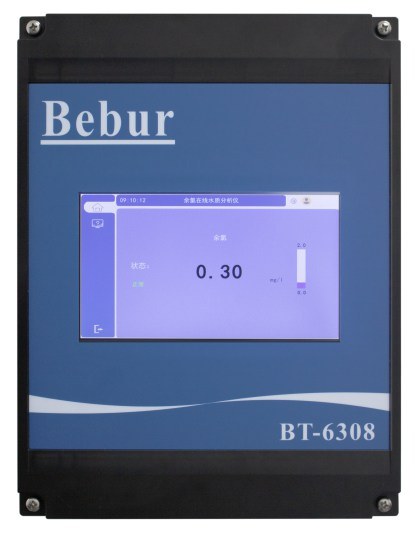
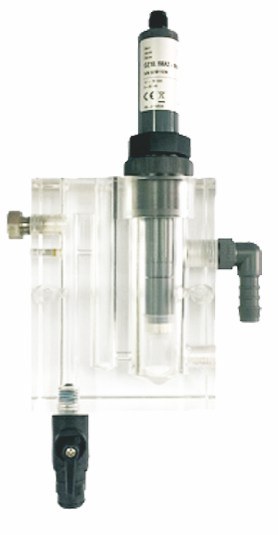
Compact and easy to operate; a reagent pump injects reagent into the sample for reaction, then DPD colorimetry measures concentration. Different reagents enable targeted residual or total chlorine measurement.
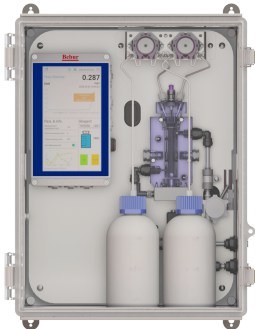
No reagents or buffer solution; 6-month maintenance-free and 3-month calibration-free, suitable for long-term continuous trend monitoring and chlorine/dechlorination interlock at hospital wastewater plants; self-cleaning unit available for heavy fouling.
Same principle as laboratory DPD titration/spectrophotometry, easing method comparison and data acceptance; large-capacity storage enables long-term retrospective water quality trends.
Need a residual chlorine monitoring configuration for your plant, or advice on electrode/DPD model selection, point layout and laboratory comparison calibration? Reach us by phone or email.