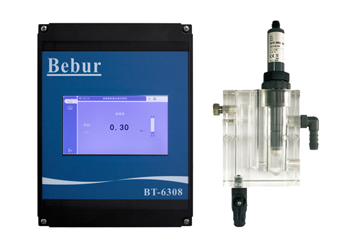
The Online Bromine Analyzer of Bebur Company adopts a membrane amperometric three-electrode sensor. It does not require the use of reagents and buffers. The measurement is stable and the performance is reliable. It can reduce the maintenance amount and save the user's usage cost.
The Online Bromine Analyzer of Bebur Company adopts a membrane amperometric three-electrode sensor. It does not require the use of reagents and buffers. The measurement is stable and the performance is reliable. It can reduce the maintenance amount and save the user's usage cost.
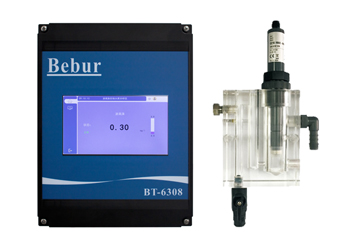
It is applicable to the detection of total bromine and free bromine in the following fields:
▪Drinking water
▪Swimming pool water
▪Industrial water
▪Seawater
▪A membrane-type amperometric polarographic three-electrode sensor is adopted
▪Stable performance and accurate measurement
▪No chemical reagents are needed
▪It is not affected by the cleaning agents in water
▪No zero-point calibration required
▪It has a relatively long service life
▪Suitable for drinking water, process water and brine
The bromine sensor is a membrane-type amperometric polarographic three-electrode sensor. This electrode can automatically adjust the potential to eliminate zero drift. This design enables water quality testing without the need for additional reagents or buffers, reducing the user's usage cost. During calibration, only high-point calibration is required (zero-point calibration is not necessary).
Type | Membrane amperometric polarographic three-electrode sensor |
Sensor model | BWBR1 |
Application | Drinking water, swimming pools, industrial water treatment and seawater |
Range | 0.05-2ppm,0.05-5ppm,0.05-10ppm |
Diaphragm material | Microporous hydrophilic membrane |
Stability | 1% per month |
pH range | 6.5-9.5 |
Temperature range | 0-45℃ |
Temperature compensation | Integrated automatic temperature compensation |
Pressure range | 0-0.5bar |
Response time | T90 takes about 2 minutes |
Flow velocity | 500ml/min |
Electrode material | PVC/PEEK stainless steel |
Calibration | When using DPD1 and DPD4, it is recommended to calibrate once every three months |
Interference | CI2, CIO2,O3 |

Tel:+86-18001379750

E-mail:sales@bebur.net

Whatsapp:+86-18518487185

Skype:+86-18518487185



 中文简体
中文简体 English