BT8500 Online Liquid Particle Counter
Light obscuration8 user-set channels1–750 μm
The BT8500 is an online liquid particle counter that measures the size and number of particles in a flowing liquid by light obscuration, continuously, 24 hours a day. A 7-inch colour touchscreen handles setup and readout, calibration is done on site, and counts reach a PLC or SCADA system over Modbus RTU/RS485 — so you can tell whether water, cleaning fluid, coolant or hydraulic fluid is still inside its cleanliness limit.
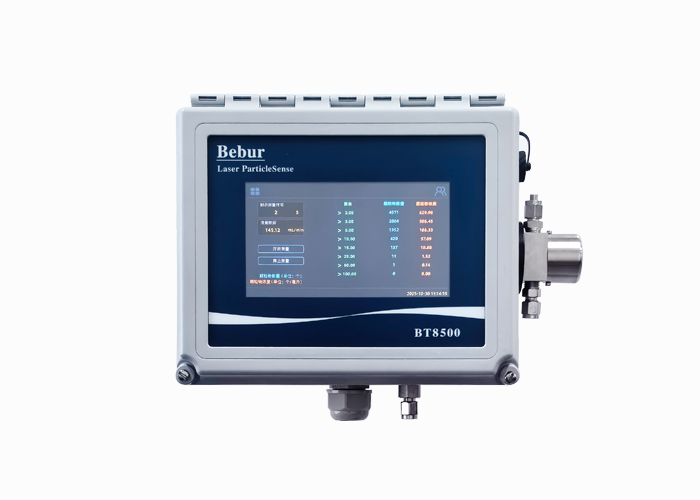
Read these four blocks first — they decide whether this instrument suits your lineAt a glance
Light obscuration: a laser beam crosses the liquid, and each particle reports its own size and countMeasurement principle
A laser beam passes through a narrow flow cell. Every particle that crosses it blocks part of the beam for a fraction of a second, and two things are read from that event: how much light was lost, which gives the particle size, and how often the beam was broken, which gives the particle count. Particles are counted one at a time, so the result is a distribution rather than an average.
Principle, simplified: a particle crossing the laser path reduces the light reaching the detector. The depth of the drop corresponds to the projected size of the particle; the number of drops corresponds to the number of particles.
-
01
Liquid enters the external sensor
The sensor is plumbed into the sample line. Liquid passes through the flow cell at 60 mL/min (1–200 μm and 2–400 μm) or 120 mL/min (2–750 μm), so particles cross the beam one at a time.
-
02
The beam is obscured — that gives the size
A 5 mW red laser diode shines through the flow cell. The larger the particle, the more light it blocks; the sensor converts the amount of light lost into particle size.
-
03
Break events give the count
Each obscuration is one break in the beam. Counting breaks yields the number of particles above that size threshold, filed into the configured channels.
-
04
The controller reports and stores
Channel values are shown live on the 7-inch touchscreen, sent out over Modbus RTU/RS485, and written to 1,000,000 on-board records.
Counts all particles larger than a given channel size — the right mode for a single pass/fail threshold on a batch.
Counts particles between two adjacent channel sizes — the right mode for size distribution and for locating where the particles come from.
Three sensors, one particle size scaleRange coverage
The controller is identical in every configuration; the measurement range comes from the sensor you fit. The scale below spreads 1–800 μm across a log axis: the three dark bands are the coverage of BSLP200, BSLP400 and BSLP750, and the red band is the instrument's standard reported size range. Begin with the particle size you most need to control, then leave some headroom above it.
All three sensors report 2–300 μm as standard. Channel count and the size assigned to each channel are set on the touchscreen: 8 channels as standard, 16 / 24 / 32 optional.
Details that come from running continuouslyDesign notes
External sensor — cleaned without opening the controller
The sensor is separate from the controller and can be taken off for cleaning. A protection filter, cleaning kit and inlet/outlet tubing ship with it, so routine maintenance does not tie up the line.
Calibration on site, no trip to the factory
Calibration is built in and performed in place to high accuracy. That removes shipping time and scheduling, which matters most when you run several units across a plant.
7-inch colour touchscreen
Setup and readout happen on the same screen. Channel values, cumulative totals and run status are visible at the panel without a laptop alongside.
8 channels to start with, sizes you define
Eight particle size channels as standard, each size set by the user. Where you need a finer breakdown of the distribution, 16, 24 and 32 channel versions are available.
Alarms, faults and maintenance prompts
Live sensor alarms and fault display flag maintenance needs. The sensor's wider temperature tolerance reduces stoppages when the process temperature moves.
Outputs that fit existing systems
Modbus (RTU)-RS485 as standard, 4–20 mA and USB optional, local or remote control. Up to 1,000,000 records are held on board for later comparison.
NEMA 4X enclosure
12 × 10 × 6 inches and 5 kg, rated for wet and washdown environments. It mounts on a machine frame or on the wall next to the sample point.
Room for water quality parameters
pH and conductivity sensors and a de-bubbling device can be added, so one sample point reports both particle cleanliness and water chemistry.
SpecificationsTechnical data
| Measurement principle | Light obscuration |
|---|---|
| Sensor | Laser sensor, 5 mW red laser diode |
| Signal-to-noise ratio | ≥ 3 : 1 |
| Size channels | 8 as standard, size per channel user-defined; 16 / 24 / 32 optional |
| Measurement range | 1–200 / 2–400 / 2–750 μm |
| Reported size range | 2–300 μm |
| Flow rate | 60 mL/min · 120 mL/min |
| Measurement precision | 10 μm < 8% 2–10 μm < 10% |
| Counting unit | Particles per mL, or total particles per measurement cycle |
| Counting mode | Cumulative / differential |
| Calibration | Built in, performed on site |
| Data output | Modbus (RTU)-RS485 as standard; 4–20 mA, USB optional |
|---|---|
| Control mode | Local / remote |
| Data storage | 1,000,000 records |
| Display | 7-inch high-resolution colour touchscreen |
| Power supply | 100–240 VAC, 0.5 A 12 VDC, 1.67 A |
| Enclosure rating | NEMA 4X |
| Dimensions | 12 × 10 × 6 in |
| Weight | 5 kg |
| Operating temperature | 5–50 °C 5–70 °C (H version) |
| Storage temperature | 0–50 °C |
| Operating humidity | 18–80% RH, non-condensing |
| Installation set | Weir FC-LPS01 or flow meter FD-MPS01 |
Figures as published by the manufacturer; confirm the configuration for your site before ordering. Range and reported size range are not the same figure: the sensor sets the measurement range, and accuracy is specified over 2–300 μm.
Certificates and complianceCE / RoHS / verification
CE marking: the instrument is declared in conformity with the European directives that apply to electrical equipment, so it can be installed and operated in EU member states.
RoHS compliant: restricted substances in electrical and electronic equipment are held within the limits set by the directive.
Verification (calibration) certificate: issued for the particle size channels and supplied with the instrument, stating the verification result and the basis it was carried out against.
The certificate in force at the time of shipment applies. Ask us for the current copies — certificate numbers, the issuing laboratory and the verified range — for your project file.
Two mounting options — choose one when you orderInstallation
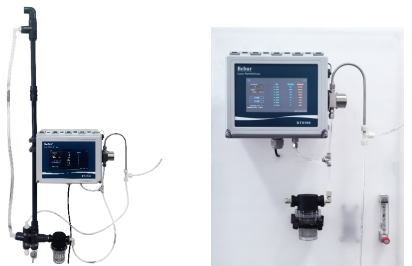
Left: weir installation (FC-LPS01) — controller on a stand with an overflow weir. Right: flow meter installation (FD-MPS01) — controller on a wall bracket above the flow meter. Both end at the same external laser sensor.
Weir installation — FC-LPS01
open tanks, troughs, wash bathsA stand carries an overflow weir. Liquid flows over the weir at a steady level and is drawn off from the side into the sensor. Suits open vessels where you take water from the edge of the bath; the short pipe run keeps the transport lag — and the chance of particles settling on the pipe wall — to a minimum.
Flow meter installation — FD-MPS01
pressurised lines, equipment cabinetsA flow meter with a bracket is fitted into the sample line, so you can set and read the sampling flow rate at the point of take-off. Suits pressurised pipework or equipment cabinets where there is no free surface to work from.
What the sensor needs either way
common to bothA liquid path through the external sensor with no air entrainment, and a flow rate that matches the sensor (60 mL/min or 120 mL/min). Where the liquid carries entrained gas, add a de-bubbling device.
Photos and part numbers are from the manufacturer's own material. Pipe connections, bracket fixing and stand height have to be confirmed against your site; tell us the take-off point and we will check the arrangement with you.
Ordering: the sensor sets the range, the mounting set sets the fitHow to specify
Every BT8500 uses the same controller — 7-inch touchscreen, 8 channels, Modbus RTU/RS485, 1,000,000 records. What changes is the sensor and the mounting set. Two choices, then send the exact model.
The table is wider than the screen — swipe sideways to see all columns.
| Item | Sensor | Range | Flow rate | Where it suits |
|---|---|---|---|---|
| BT8500 | BSLP200 | 1–200 μm | 60 mL/min | Industrial process water, parts cleaning, drinking water — fine particles dominate |
| BT8500-H | BSLP200H | 1–200 μm | 60 mL/min | As above, liquid or ambient up to 70 °C |
| BT8500 | BSLP400 | 2–400 μm | 60 mL/min | Fine and coarse both matter — filtration, equipment wear |
| BT8500-H | BSLP400H | 2–400 μm | 60 mL/min | As above, high temperature |
| BT8500 | BSLP750 | 2–750 μm | 120 mL/min | High coarse fraction, or the wider size span |
| BT8500-H | BSLP750H | 2–750 μm | 120 mL/min | As above, high temperature |
| FC-LPS01 | Weir installation — stand, overflow weir, pipework |
|---|---|
| FD-MPS01 | Flow meter installation — flow meter, bracket, pipework |
| Controller | BT8500, 7-inch touchscreen, Modbus RTU/RS485 |
|---|---|
| Sensor | BSLP series, selected range |
| Accessories | Sensor protection filter, cleaning kit, inlet/outlet tubing |
| Options | 16 / 24 / 32 channels · 4–20 mA · USB · pH sensor · conductivity sensor · de-bubbling device |
Where an online counter earns its placeApplications
Industrial process water
Watch particle levels at the point of use instead of sampling and waiting for a lab result.
Parts cleaning
Cleaning fluid carries particles off the parts. Counting them shows when the bath needs changing.
Drinking water treatment
Follow particle removal through filtration and clarify where a step stops performing.
Lubricating and hydraulic fluid
Particles are wear debris. Continuous counting catches equipment wear before it becomes a failure.
Liquid cooling loops
Coolant and cold plates foul from particles. Counting proves whether a cleaning cycle worked.
Fluid cleanliness monitoring
Trend a system against its own cleanliness limit and keep a record over time.
Membrane filtration
Particles in permeate and feed show breakthrough and the condition of the membrane.
Food and beverage
Process water and product liquid monitored for particle content on the line.
Pharmaceutical and medical water
Purified water and process liquid checked for particles where the record has to be continuous.
Electronics manufacturing
Process chemicals and rinse water held to a particle limit, batch after batch.
In the fieldInstallations
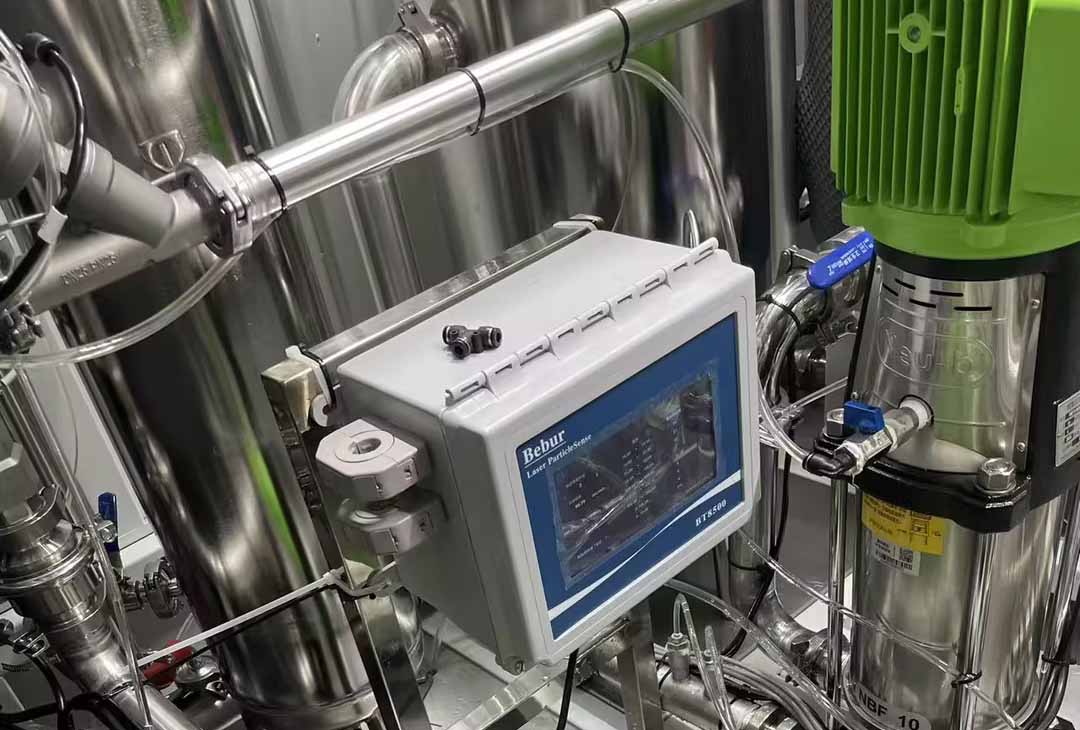
On-site liquid-cooled component flow path cleaning equipment: multiple cleaning stations run in parallel, and the BT8500 online liquid particle counter is used to monitor particle residues in the cleaning circuit to confirm whether the flushing meets the requirements.
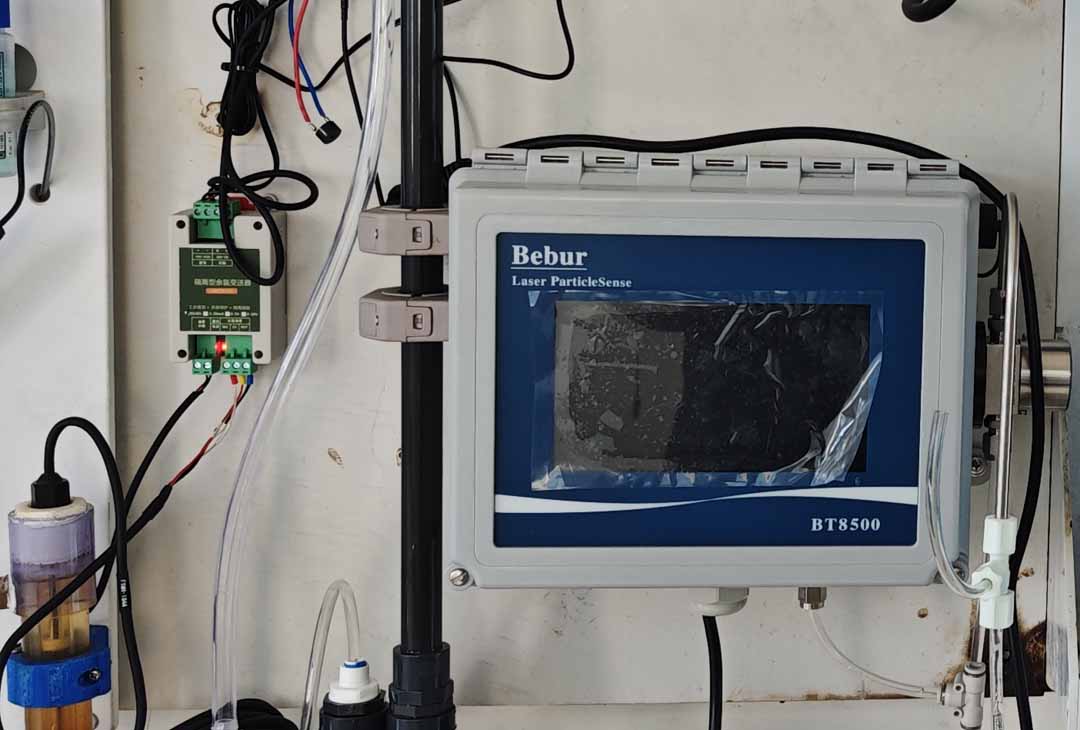
BT8500 online liquid particle counter installation on a tap water plant overflow weir: The external sensor is connected to the nearby sampling pipeline. During maintenance, you only need to remove the sensor, without moving the whole machine.
Site photos show the instrument in service; pipe routing and cabinet arrangement are specific to those installations.
Questions that come up before orderingFAQ
How does the BT8500 measure particles in a liquid?
Which measurement range should I choose: 1–200, 2–400 or 2–750 μm?
Can the eight particle size channels be set by the user?
What is the difference between cumulative and differential counting?
How is it connected to a PLC or SCADA system?
Does the instrument have to go back to the factory for calibration?
How is the sensor cleaned and maintained?
Can it be used at high temperature, or with liquid carrying bubbles?
Which liquids can it monitor?
What is in the standard supply?
Does the BT8500 come with CE, RoHS and calibration certificates?
Tell us the liquid and the limit — we will come back with a configurationContact
The useful details are short: what the liquid is, its temperature, whether the take-off point is a pressurised line or an open tank, and the particle size or cleanliness limit you have to meet. With those we can say which sensor and which mounting set you need, and whether the H version applies.
For distributors and OEM integrators: the controller is identical across ranges, so spares and training cover the whole family.
Full specifications, sensor tables and the ordering list, in one file you can forward internally.
Open the PDFSource: product information and photographs from the manufacturer's BT8500 page (bebur.net). Figures are reproduced as published; where a value is a recommendation rather than a specification, it is marked as one. Page updated 13 November 2026. If a specification has changed since, the manufacturer's current datasheet takes precedence.