Source:本站Date:2026-08-21
Application Case of Bebur BT 525 Series Exhaust Ozone Concentration Monitor at Beian Water Purification Plant
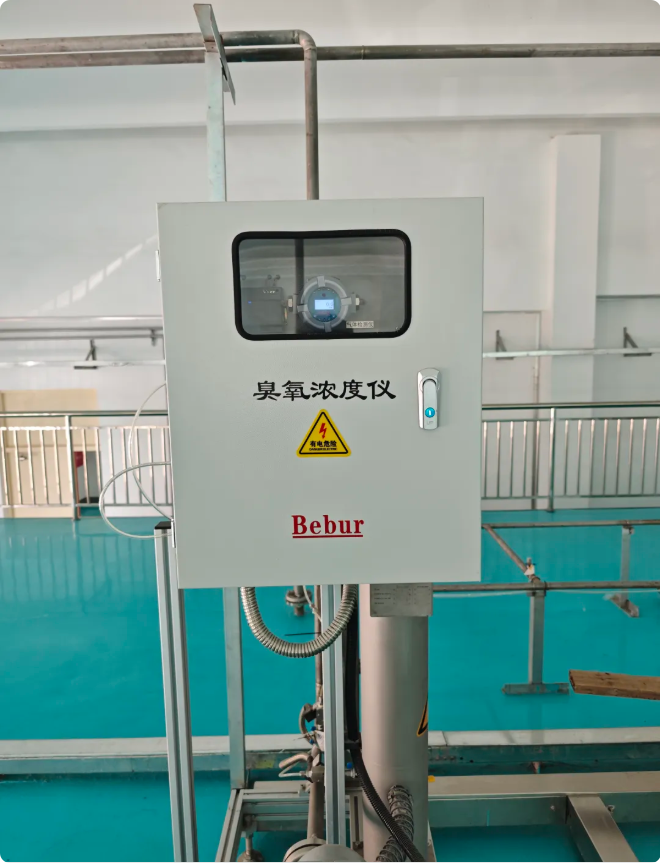
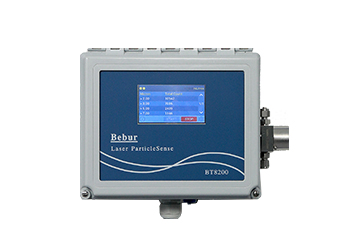
Installed at the outlet of the ozone tail-gas destructor of Beian Water Purification Plant, the Bebur BT-525 Series Exhaust Ozone Concentration Monitor, paired with a dedicated dehumidification and dust-removal pretreatment unit, delivers accurate online monitoring of residual ozone concentration in exhaust gas and quantitatively evaluates destruction performance in real time. It triggers automatic audible-visual alarms for over-limit conditions and supports interlock emergency shutdown of the ozone generator, mitigating risks of excessive emissions at the source.
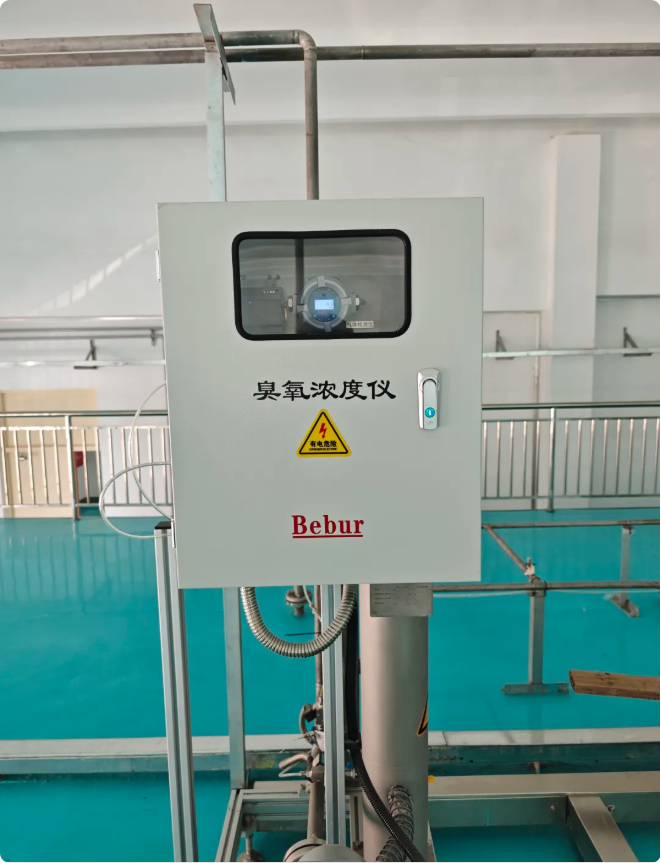
End-user: Beian Water Purification Plant, Heilongjiang Province Equipment deployed: BT-525 Series Exhaust Ozone Concentration Monitor Application scenario: Online monitoring of residual ozone at the outlet of tail-gas destructor for ozone advanced treatment process in municipal water supply Applicable standards: GB 28232-2020 Hygienic Requirements for Ozone Disinfectors; GB 3095-2026 Ambient Air Quality Standards; GB/T 37894-2019 Technical Requirements for Ozone Generators for Water Treatment
To stabilize finished-water quality and degrade trace organic contaminants and odor-causing substances, Beian Water Purification Plant adopts an ozone-biological activated carbon advanced treatment process equipped with an ozone tail-gas destructor. Subject to high-latitude northern climate and process characteristics, the plant faced the following shortcomings in tail-gas emission control:
· Fluctuated catalytic efficiency in cold winter: Low ambient temperature reduces catalyst activity of the tail-gas destructor, which easily leads to excessive emission concentrations. Manual intervention cannot respond in a timely manner, bringing non-compliance environmental risks.
· Lack of data basis for catalyst replacement: Catalyst replacement was determined purely by operational experience. Premature replacement caused unnecessary consumable waste, while undetected catalyst failure resulted in ozone leakage and potential hazards to operators’ occupational health.
· Insufficient risk prevention without interlock control: No automatic early-warning or linkage function to reduce load or shut down the ozone generator upon over-limit readings. Extended faults may cause large-scale ozone leakage and safety incidents.
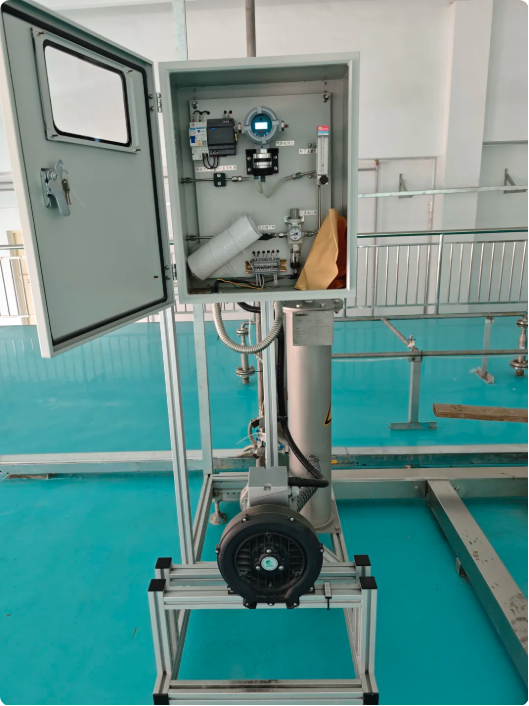
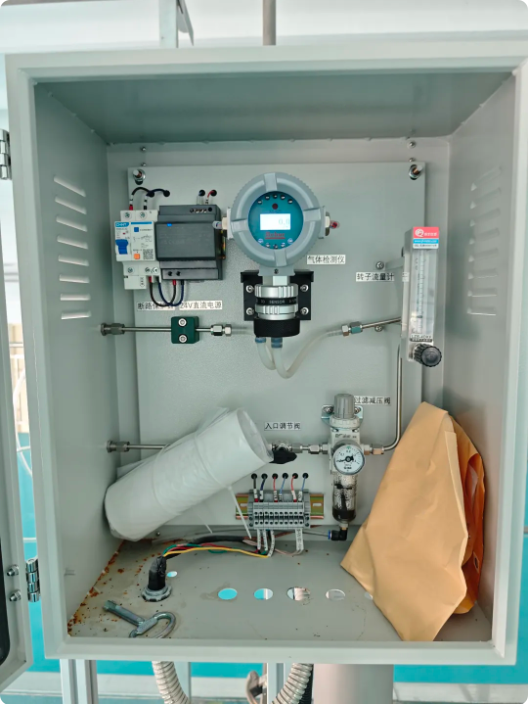
The field-deployed Bebur BT-525 Series Exhaust Ozone Concentration Monitor is a pump-driven online monitoring instrument adopting high-precision electrochemical sensors with built-in temperature compensation modules. Equipped with a tail-gas pretreatment unit for dehumidification, dust removal and flow stabilization, it eliminates interferences from water vapor and impurities. Custom-developed for water plants under high-humidity, low-temperature and pressurized tail-gas conditions, it addresses common drawbacks of conventional detectors such as poor anti-interference performance, inaccurate readings under low temperature and frequent failures, with greatly improved working-condition adaptability and operational stability.
· Active pump-sampling unit: Provides stable active sampling power, adapting to alternating slight positive and negative pressure inside the tail-gas pipeline, ensuring continuous and uniform sampling and avoiding sampling interruption or uneven sampling.
· Multi-stage pretreatment system (filtration, dehydration, pressure stabilization): Removes water vapor, dust and solid impurities in tail gas layer by layer, preventing sensor contamination by winter condensation, data drift and gas-path blockage commonly seen in northern regions.
· Rotor flowmeter for flow stabilization: Maintains constant sampling flow precisely, stabilizes intake conditions of the electrochemical sensor chamber, avoids value fluctuation induced by airflow disturbance, and significantly improves detection accuracy and repeatability.
· Power distribution & protection unit: Comprises regulated power supply, circuit breaker and terminal blocks, adapting to complex electrical environments in water plants. It delivers stable power supply and strong anti interference capability to reduce equipment failure rates.
With integrated pretreatment gas circuit, pump-driven sampling and low-temperature-adapted hardware, the Bebur BT-525 Series Exhaust Ozone Concentration Monitor resolves typical pain points of northern alpine water plants including condensation in ozone tail-gas monitoring, unstable accuracy, extensive operation-maintenance modes and difficult environmental-protection traceability. It transforms traditional experience-based management into data-driven closed-loop online monitoring, realizing multiple values including water-supply safety, occupational-health protection, environmental compliance and operational cost reduction. It provides a replicable practical reference for municipal water purification plants and county-level water supply stations with ozone advanced treatment in Heilongjiang Province.
Q: What is the difference between an exhaust-gas ozone concentration monitor and an ozone leakage detector?
A: Ozone leakage detectors apply diffusion sampling for ambient-air ozone monitoring and focus on occupational-safety early-warning. Exhaust ozone concentration monitors adopt pump-driven pipeline sampling, specially designed for high-humidity and pressurized conditions inside discharge pipelines. Their core function is to verify tail-gas destructor efficiency and judge emission compliance. They differ in monitoring scenarios, accuracy requirements and installation methods.
Q: Can the exhaust ozone concentration monitor directly interlock with the ozone generator?
A: Yes. The device is equipped with relay alarm outputs that can be directly connected to the control loop of the ozone generator to trigger load reduction or emergency shutdown when concentrations exceed limits. Interlock control can also be realized via PLC transfer.
Q: What is the routine maintenance workload and annual operation-maintenance cost?
A: The core electrochemical ozone sensor features a service life of 2-3 years with no high-frequency wearing parts. Routine work mainly includes checking gas-path smoothness, periodic zero-point calibration and replacing pre-treatment filter cartridges as required. It features simple maintenance, low failure rate and low annual maintenance cost, matching lightweight operation-maintenance requirements for water plants.
Q: How to judge whether the tail-gas destructor fails via this instrument?
A: With stable ozone generator dosage, continuously rising exhaust ozone concentration that stays above threshold indicates declining catalyst decomposition efficiency. Inspect catalyst activity or arrange replacement promptly to avoid excessive emissions and safety hazards.

Tel:+86-18001379750

E-mail:sales@bebur.net

Whatsapp:+86-18518487185

Skype:+86-18518487185



 中文简体
中文简体 English