Source:本站Date:2026-08-07
Core Conclusion
Bei’an Water Purification Plant has purchased two sets of Bebur UVSense UV‑based COD analyzers, installed respectively in the activated carbon filter workshop and the water delivery outlet, establishing a dual‑node organic matter online monitoring system covering process monitoring plus finished‑water terminal supervision. Adopting purely optical measurement, the instrument requires no chemical reagents or high‑temperature digestion, and delivers fast response for real‑time tracking of organic‑matter concentration variations. It eliminates workloads associated with chemical management and waste‑liquid disposal.
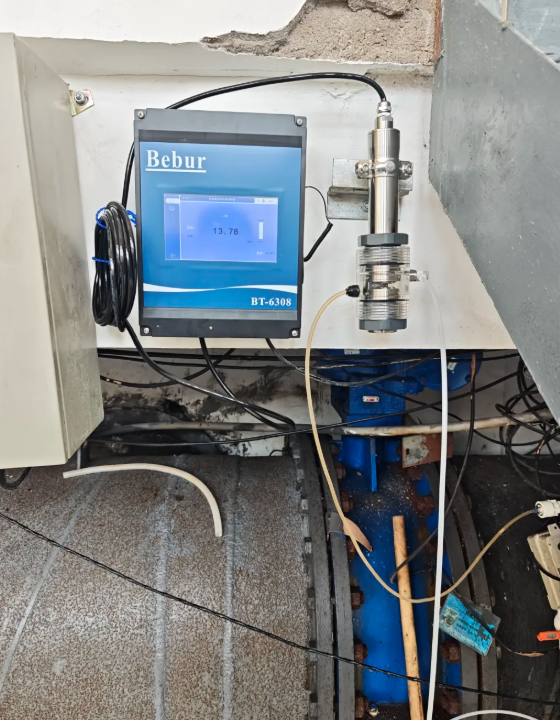
End‑user: Bei’an Water Purification Plant, Heilongjiang Province
Equipment deployed: 2 units of Bebur UVSense Chemical Oxygen Demand (COD) Analyzer
Measuring principle: UV spectral absorption method (254 nm characteristic absorption plus turbidity compensation)
Installation points: ① Activated carbon filter workshop; ② Water‑delivery outlet (finished‑water main pipeline)
Core values: Evaluate organic‑matter removal efficiency of biological activated carbon filters; monitor organic‑matter concentration in finished drinking water to ensure stable compliance with the permanganate index limit ≤ 3 mg/L specified in GB 5749‑2022.
Applicable standards: GB 5749‑2022 Standards for Drinking Water Quality, CJ/T 206‑2005 Water Quality Standard for Urban Water Supply
Note: Besides Bebur UVSense COD analyzers, Bei’an Water Purification Plant also procured Bebur streaming current analyzers for automatic chemical‑dosing control in coagulation process, as well as ozone monitors for online ozone concentration measurement at ozone generator outlets.
Located in northern Heilongjiang, Bei’an Water Purification Plant adopts a treatment process of “conventional treatment plus ozone‑biological activated carbon advanced treatment” and supplies tap water for the main urban area. Its source water is surface reservoir water from Naolonghe Reservoir and Shankou Reservoir, featuring obvious seasonal water‑quality characteristics. Snow‑melt runoff in spring brings humus substances; rainfall‑induced flood events in summer cause short‑term rises in organic‑matter concentration; low‑temperature‑low‑turbidity conditions in winter reduce organic‑matter removal performance. The advanced‑treatment section removes trace organic matter via activated carbon adsorption, and the finished water must meet the mandatory permanganate‑index limit ≤ 3 mg/L defined in GB 5749‑2022.
Before retrofitting, organic‑matter indicators were measured solely by laboratory titration for permanganate index. Long testing cycles led to delayed data, making it impossible to capture sudden water‑quality shocks in real time. Heavy workloads existed for chemical‑reagent procurement, storage and waste‑liquid disposal. The operational status of activated carbon filters was judged empirically without continuous online data support. Moreover, real‑time early‑warning capability for finished‑water organic‑matter was absent, creating hidden risks for drinking‑water safety.
To strengthen process monitoring for advanced‑treatment sections and terminal supervision over finished water, the water plant deployed two Bebur UVSense UV‑based COD analyzers at the activated carbon filter workshop and the finished‑water delivery main pipeline, constructing the dual‑node organic‑matter online monitoring system for process‑side and terminal‑side supervision.
The Bebur UVSense COD Analyzer works on the UV spectral absorption principle. Aromatic organic substances in water exhibit characteristic ultraviolet absorption at 254 nm. Built‑in turbidity‑compensation algorithms automatically counteract measurement interferences caused by suspended solids, and convert optical signals into equivalent COD (permanganate index) readings.
This purely‑optical analyzer requires no chemical reagents or high‑temperature digestion, and features fast response. It is well‑suited for continuous monitoring of low‑concentration organic matter in drinking‑water‑source surface water.
Reagent‑free & zero waste liquid: No hazardous chemicals such as potassium permanganate or concentrated sulfuric acid are consumed. No toxic waste liquid is generated. Burdens from chemical management and waste‑liquid disposal are removed, complying with water‑plant safety‑production requirements.
Second‑level response, no digestion required: Pure optical measurement without heating‑digestion; measurement cycle of 30 seconds, enabling real‑time capture of organic‑matter shocks in source water.
Adaptable to cold‑climate conditions: Built‑in automatic temperature compensation accommodates huge temperature fluctuations between winter and summer in northern China.
Low maintenance workload: No reagent replacement or frequent pipeline clogging risks. Sensor‑integrated automatic mechanical brush‑cleaning greatly reduces on‑site operational workload.
Rich signal interfaces: Supports 4‑20 mA analog output and RS485 Modbus RTU communication, for direct connection to existing plant PLC and smart‑water‑platform systems.
| Item | Specification |
|---|---|
| Measuring Principle | UV spectral absorption (254 nm + turbidity compensation) |
| Measuring Range | 0‑500 mg/L |
| Accuracy | ±2.5 % FS |
| Resolution | 0.01 mg/L |
| Operating Temperature | 0‑50 °C |
| Temperature Compensation | Automatic compensation |
| Sensor Self‑cleaning | Mechanical brush cleaning |
Two UVSense UV COD analyzers are installed with bypass flow‑cell sampling configuration, covering both advanced‑treatment‑process monitoring and finished‑water terminal supervision to form a complete organic‑matter monitoring chain.
Monitoring Objective: Evaluate organic‑matter removal efficiency of biological activated carbon filters.Process Values:
Dynamically track the adsorption saturation status of carbon beds. Replace the traditional fixed‑cycle carbon‑replacement strategy to avoid unnecessary consumable waste caused by premature carbon replacement.
Guide optimization of filter‑backwashing frequency. Prolong backwashing cycles under qualified effluent‑water‑quality conditions to cut water‑and‑power consumption for backwashing.
Adjust ozone dosage and filter operating parameters in advance upon incoming‑water organic‑matter shocks, stabilizing effluent quality from carbon filters.
Monitoring Objective: Terminal‑side monitoring of organic‑matter concentration in finished water to guarantee stable compliance with GB 5749‑2022 permanganate‑index limit ≤ 3 mg/L.Process Values:
24‑hour continuous online monitoring of organic‑matter in finished water. Trigger alarms when readings approach national‑standard limits, with alarm signals transmitted to central control and operation staff.
Automatic storage of continuous monitoring data, satisfying archiving requirements for water‑group assessment and regulatory traceability.
Realize data linkage with readings from the activated‑carbon‑filter point, restoring the full‑plant organic‑matter removal process.
Q: Can the UV‑spectral COD analyzer fully replace national‑standard laboratory testing?
A: The UVSense UV‑based analyzer is designed for continuous process monitoring and water‑quality early warning. Quarterly calibration against laboratory permanganate‑index testing is required. Official regulatory reporting shall adopt national‑standard laboratory methods.
Q: Does the UVSense COD analyzer truly require zero chemical reagents?
A: Yes. Adopting purely optical UV‑absorption technology, it uses no chemical reagents throughout operation and generates zero waste liquid. No regular reagent‑consumable replacement is needed, bringing low‑cost operation and maintenance.
Q: Can this instrument connect to existing water‑plant automatic‑control systems?
A: Equipped with 4‑20 mA and RS485 Modbus RTU interfaces, it can connect to most existing water‑plant PLCs and smart‑water‑platforms without additional hardware.
2026-08-14

2026-08-07
2025-11-20
2025-11-20

2025-11-20

Tel:+86-18001379750

E-mail:sales@bebur.net

Whatsapp:+86-18518487185

Skype:+86-18518487185



 中文简体
中文简体 English