BTP8300 Portable Liquid Particle Counter
Particle contamination analyzer · Light obscuration · On-site calibration
The BTP8300 measures the size and number of solid particles in liquids by light obscuration. Three ranges cover 1–750 µm, with 8 channels as standard and up to 32, and a single test takes under two minutes. It travels in a protective case with a carry bag, ready for the laboratory or the field.
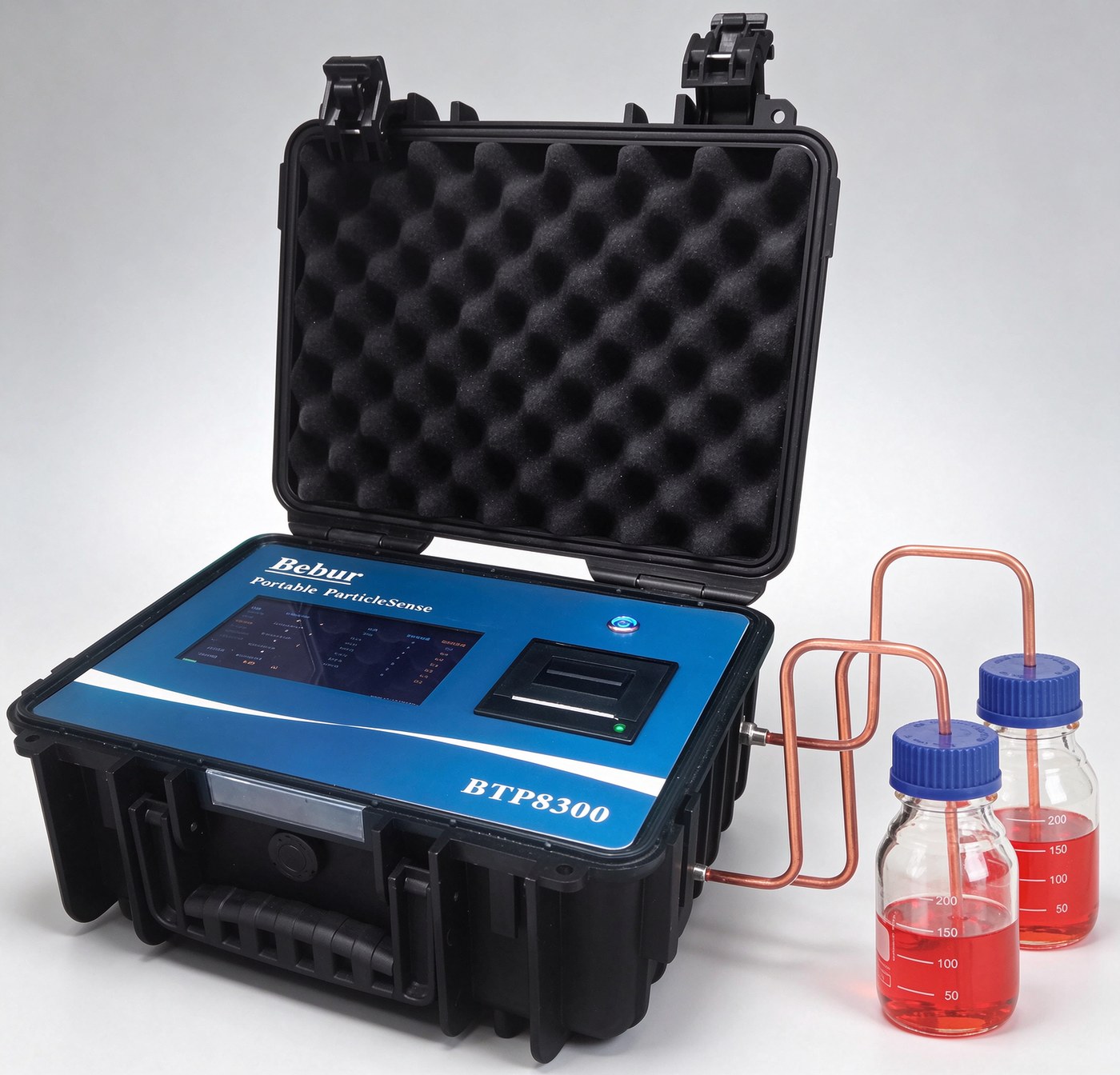
Particle contamination, measured by light obscuration
The BTP8300 is a liquid particle counter built to travel. It measures solid particles suspended in a liquid and reports their size and count.
Bebur's BTP8300 portable liquid particle counter uses light obscuration to measure the size and number of solid particles in liquids. As a particle passes between the laser diode light source and the detector, it blocks part of the beam and reduces the light signal the detector receives. That reduction is proportional to the particle's equivalent size, which is how the instrument quantifies particle contamination in a liquid.
The instrument is used for oil cleanliness testing, flocculation optimization, oilfield injection water, tap water and lake water. Fast measurement, strong interference resistance, high accuracy and good repeatability make it suitable for industrial production, research laboratories and quality control.
On-site software calibration means the unit does not have to return to the factory, so maintenance does not interrupt operation. Mains or battery power lets the same instrument run on a bench or at a sampling point in the field.
A particle blocks the beam, and the instrument reads its size
Light obscuration works on attenuation: the larger the particle, the more light it blocks. Each attenuation event is converted into a particle size and counted by channel, producing a size distribution for the liquid.
A laser diode illuminates a flow cell. Particles crossing the beam reduce the light reaching the detector, and the reduction is proportional to the particle's equivalent diameter.
Sample flows through the cell
Sample enters the flow cell through the inlet tubing. Particles pass the laser beam one by one, and waste exits through the outlet tubing.
A particle blocks the beam
While a particle sits between the light source and the detector, it blocks part of the light and the detector signal drops briefly.
Size is calculated and counted
The signal drop corresponds to the particle's equivalent size. The instrument counts particles in each size channel and reports the count and distribution.
Ten features that cover the whole field workflow
Sampling, measurement, calibration, printing and archiving are handled inside one instrument, so a sample taken on site comes back as a result that can be filed.
Wide measuring range
1–200 µm, 2–400 µm and 2–750 µm ranges cover different particle testing requirements.
Customizable channels
Up to 32 user-defined channels, with custom configurations up to 1000 channels for specific standards.
Real-time functions
Real-time alarms, data storage, printing, calibration, self-test and data download in one unit.
On-site calibration
Software calibration can be performed on site. No factory return is needed.
Sensor signal output
Analog sensor signal output makes it easy to check the sensor's working status.
Service-friendly design
The external sensor is easy to inspect and clean, so routine maintenance does not require dismantling the instrument.
Dual power supply
Runs on mains power or a battery pack, for laboratory or field operation.
High accuracy
Accuracy is better than ±5% at 2 µm and better than ±10% from 5 to 10 µm.
Fast measurement
A test takes no more than 2 minutes, which keeps multi-point sampling efficient.
Strong interference resistance
A laser diode source and light obscuration give strong anti-interference performance and good repeatability.
From aviation fuel to lake water, three groups of use cases
The BTP8300 measures solid particles in liquid, so any application that depends on fluid cleanliness falls within its scope.
Industries
Nine sectors that depend on oil and fluid cleanliness.
- Military logistics
- Aerospace
- Power generation
- Petrochemical
- Transportation
- Ports and logistics
- Metallurgy
- Machinery
- Automotive manufacturing
Oil testing
Particle contamination testing for the following fluids.
- Aviation kerosene contamination
- Hydraulic oil cleanliness
- Lubricating oil particle counting
- Transformer (insulating) oil contamination
- Turbine oil contamination
- Gear oil analysis
- Engine oil particle testing
- Water-based hydraulic fluid contamination
Liquid analysis
Non-oil liquid samples and process monitoring.
- Insoluble particles in organic liquids
- Particle analysis in polymer solutions
- Filtration monitoring (filter beds, membrane filters, ceramic filters)
- Finished product quality (purified water, medical-grade water, detergents)
- Process optimization (flocculation, oilfield injection water)
- Equipment wear and fluid cleanliness checks
- Research and analysis
BTP8300 full specifications
The table lists the published nominal specifications. Range, channel count and accessories are configuration options, so confirm the final scope with sales before ordering.
| Item | Specification |
|---|---|
| Measurement | |
| Particle size range | 1–200 µm / 2–400 µm / 2–750 µm (three ranges) |
| Measurement channels | 8 channels standard with user-set size thresholds (optional 16 / 24 / 32); up to 32 user-defined channels, custom configurations to 1000 |
| Flow rate | 5–60 mL/min, user-settable |
| Test time | ≤2 minutes |
| Coincidence error limit | 10,000 particles/mL |
| Accuracy | 2 µm: better than ±5%; 5–10 µm: better than ±10% |
| Functions | |
| Printing | Data plots and full reports; built-in printer for hard copy |
| Calibration | Manual and automatic calibration; automatic flushing and flush verification; system alarms; on-site software calibration |
| Other functions | Self-test (at start-up or scheduled); online monitoring; PC communication; USB and I/O ports; analog sensor signal output |
| Data management | Data storage and download; USB drive data export |
| Power and physical | |
| Power supply | 110–240 VAC worldwide; mains or battery operation |
| Dimensions | 30.5 × 25 × 15 cm |
| Weight | 2.5 kg (excluding battery pack) |
| Accessories | |
| Standard | Inlet and outlet tubing; instrument carry bag |
| Optional | Sensor cleaning kit; calibration kit |
Note: the sensor is mounted externally for easy inspection and cleaning. Specifications are subject to the supplied technical documentation and factory calibration. Where this page differs from earlier brochures, the figures here and the manufacturer's latest documentation apply.
Ten questions about the BTP8300
Answers are based on the official product page and brochure, covering principle, range, channels, calibration, data handling and accessories.
How does the BTP8300 measure particles?
It uses light obscuration. A laser diode beam passes through a flow cell; when a particle crosses the beam it blocks part of the light and the detector signal drops. The drop is proportional to the particle's equivalent size, and the instrument counts particles by size channel.
What particle size range does the BTP8300 cover?
Three ranges are available: 1–200 µm, 2–400 µm and 2–750 µm. Particles below 1 µm are outside the specified range of these three configurations.
Can the measurement channels be customized?
Yes. The standard configuration has 8 channels with user-defined size thresholds. 16, 24 and 32 channel versions are available, and custom configurations can go up to 1000 channels.
How long does one test take, and what is the flow rate?
A single test takes no more than 2 minutes. The flow rate is 5–60 mL/min and can be set by the user.
Does on-site calibration require returning the instrument?
No. Manual and automatic calibration are supported, and software calibration can be performed on site. Automatic flushing, flush verification and system alarms are also included.
How is data printed and exported?
A built-in printer produces data plots and full reports as hard copy. Data can be stored and downloaded to a USB drive, and USB and I/O ports support PC communication and online monitoring.
What are the power and physical specifications?
The instrument runs on 110–240 VAC worldwide and can also be powered by battery. Dimensions are 30.5 × 25 × 15 cm and weight is 2.5 kg excluding the battery pack.
Which liquids can the BTP8300 test?
It is used for particle contamination testing of aviation kerosene, hydraulic oil, lubricating oil, transformer (insulating) oil, turbine oil, gear oil, engine oil and water-based hydraulic fluid, as well as tap water, lake water and oilfield injection water, insoluble particles in organic liquids and polymer solutions, filtration monitoring, finished product quality control and research.
What is included as standard?
Standard accessories are inlet and outlet tubing and an instrument carry bag. A sensor cleaning kit and a calibration kit are available as options.
What does the 10,000 particles/mL coincidence error limit mean?
It is the specified coincidence error limit. Near this concentration, multiple particles may pass through the light path at the same time and cause counting errors. Whether a higher-concentration sample needs dilution or pre-treatment depends on the sample; please consult Bebur technical support.
Request a configuration and quotation for the BTP8300
Tell us the size range, channel count, whether a battery pack is needed, and the sample type. Sales and technical support can confirm the configuration and send the full brochure.