Why Turbidity Monitoring Matters in Liquid Cooling
Turbidity is a key indicator of coolant cleanliness — its value directly reflects the amount of suspended impurities in the coolant. Rising turbidity means particles are accumulating in the loop, threatening cold plate microchannels, pump seals and quick-connect couplings long before flow restrictions become visible.
For data center liquid cooling pipelines, industry standards such as T/GDSS 021-2026 require turbidity to stay below 10 NTU after system flushing. Real-time online monitoring with the BS-TURB113 keeps this cleanliness level visible throughout operation, not just at acceptance.
How It Works
The BS-TURB113 operates on the optical transmission principle. An LED emitter transmits light of a specific wavelength into the coolant; a receiver captures the light that has passed through. When suspended impurities are present, the light is scattered and absorbed, so the received intensity weakens. By measuring this attenuation, the sensor precisely calculates the turbidity value.
Thanks to this measuring principle and its sapphire measuring window, the sensor captures subtle turbidity changes without being affected by reflections from stainless steel pipes — a common interference source in metal liquid cooling loops.
Product Overview
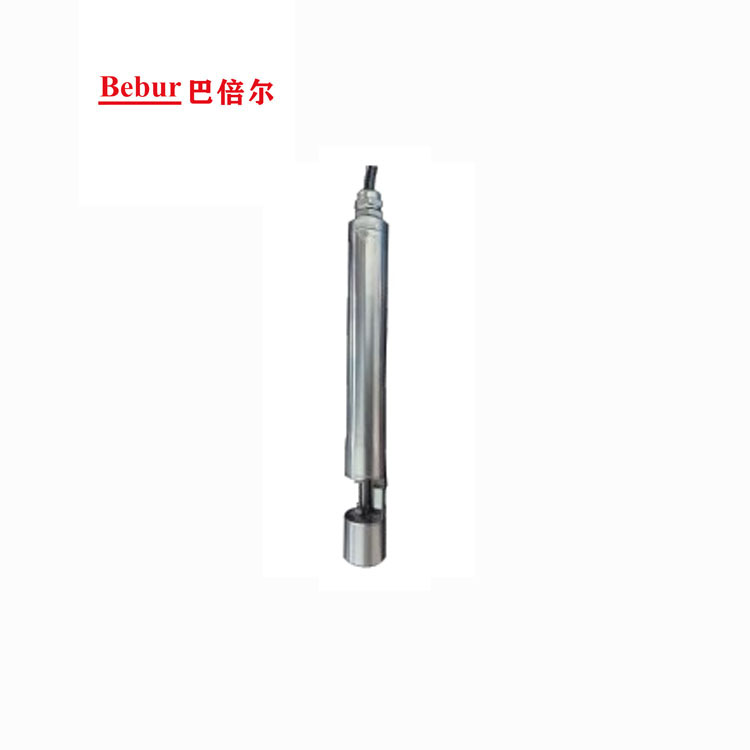
BS-TURB113 at a Glance
- Measuring Range0–10 NTU / 0–100 NTU
- Resolution0.001 NTU
- Response Time< 30 s (10 s measuring cycle)
- Repeatability≤ 1%
- Light SourceLED
- Digital OutputRS485
- Suitable MediaPure water, DI water, PG25/EG25
- Self-CleaningOptional cleaning brush
Key Features
Real-Time Online Monitoring
Continuous in-line measurement with a 10-second measuring cycle and <30 s response for live coolant cleanliness data.
Sapphire Measuring Window
Scratch-resistant sapphire window, immune to reflections from stainless steel pipes — a unique advantage in metal cooling loops.
Integrated All-in-One Design
No external transmitter module required; high precision, simple operation and high reliability in one compact probe.
Optional Self-Cleaning Brush
Automatic brush cleaning keeps the optical window clear during long-term operation, reducing maintenance visits.
IP68 Submersible-Grade Protection
316L stainless steel and titanium alloy body rated IP68, working pressure below 6 bar.
Fine 0.001 NTU Resolution
Resolves cleanliness changes far below the 10 NTU acceptance limit, catching contamination trends early.
Technical Specifications
| Parameter | Specification |
|---|---|
| Model | BS-TURB113 |
| Suitable Media | Pure water, deionized water, PG25/EG25 |
| Measuring Range | 0–10 NTU / 0–100 NTU |
| Resolution | 0.001 NTU |
| Response Time | < 30 s (10 s measuring cycle) |
| Light Source | LED |
| Repeatability | ≤ 1% |
| Load | 120 Ω |
| Digital Output | RS485 |
| Ambient Temperature | 0–50 °C |
| Body Material | 316L stainless steel, titanium alloy |
| Self-Cleaning (Optional) | Cleaning brush |
| Working Pressure | < 6 bar |
| Dimensions | Φ30 × 267 mm |
| Protection Rating | IP68 |
Dimensions & Ordering Guide
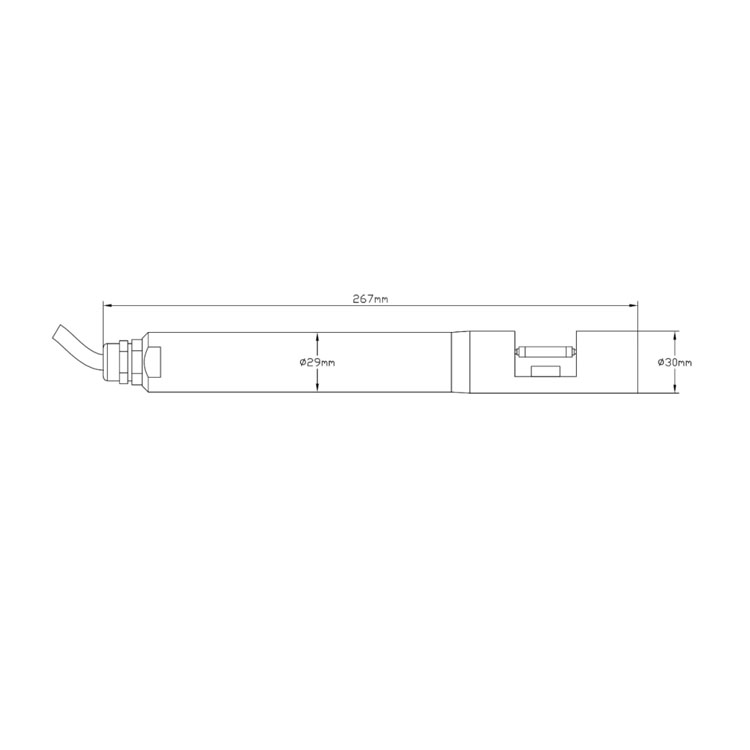
The sensor body measures Φ30 × 267 mm. Two range versions are available when ordering:
- BS-TURB113-A — 0–10 NTU
- BS-TURB113-B — 0–100 NTU
Typical Applications
- Data center liquid cooling — cold plate and immersion cooling loops, CDU primary/secondary side coolant monitoring, flushing acceptance verification
- Energy storage systems — liquid-cooled battery pack coolant cleanliness monitoring
- High-power electronics — cooling water quality for power electronics and industrial drives
The BS-TURB113 works alongside the BS-PHS276 Liquid Cooling pH Sensor, the BS-EC350 Liquid-Cooled Conductivity Sensor and the liquid particle counter to form a complete coolant cleanliness monitoring package.
Frequently Asked Questions
What is the BS-TURB113 Liquid-Cooled Turbidity Sensor used for?
How does the BS-TURB113 turbidity sensor work?
What measuring ranges are available for the BS-TURB113?
What media is the BS-TURB113 compatible with?
Does the BS-TURB113 offer a self-cleaning option?
Related Products
- BS-PHS276 Liquid Cooling pH Sensor
- BS-EC350 Liquid-Cooled Conductivity Sensor
- Liquid Particle Counter
- Streaming Current Detector
Reliable Turbidity Monitoring for Liquid Cooling
Suspended particles are the earliest sign of coolant contamination — and with 0.001 NTU resolution, a sapphire window and optional self-cleaning, the BS-TURB113 catches them before they reach cold plate microchannels. Immune to stainless steel pipe reflections, it delivers trustworthy data where generic turbidity sensors struggle.
Contact the Bebur team for selection advice, datasheets and project pricing.